

- Case Study -
Debottling Downstream Processes with Single-Pass Tangential Flow Filtration (SPTFF):
As titers continue to increase, downstream processes need to match efficiency to avoid causing roadblocks.
The Challenge
The continuous increase in upstream productivity, with titers now regularly exceeding 8–10 g/L, has shifted the bottleneck to downstream processes, particularly to filtration and chromatography unit operations. Higher titers translate directly into larger amounts of API to purify and larger volumes to handle. AGC Biologics is focused on improving manufacturing efficiency and productivity while simultaneously reducing the cost of goods (COGs) by developing intensified and continuous processes. Single-Pass Tangential Flow Filtration (SPTFF) is a technology that minimizes operational volumes and optimizes process time by concentrating the product of interest in-line in a single pass, eliminating the need for the recirculation required by traditional TFF. This technology has the potential to not only optimize downstream manufacturing but also to link upstream and downstream stages, facilitating seamless continuous processing.
In TFF, the product is recirculated through the membrane over numerous passes until the desired concentration factor is achieved. Conversely, SPTFF operates at a steady state, with the feed passing through the module only once. This is achieved by arranging multiple membranes in series to increase the path length. To ensure effective separation in a single pass, the residence time within the feed channels is increased by reducing the feed flow rate and extending the path length through a serial configuration of membrane cassettes. This increased residence time results in higher conversion, achieving the desired product concentration and concentration factor. Consequently, this directly reduces the shear stress to which the molecule is subjected.
When transitioning from traditional TFF to SPTFF, the total processing time is typically reduced. Furthermore, SPTFF is an extremely versatile technology; it can be applied to all types of biologics, including monoclonal antibodies, bispecifics, trispecifics, and other complex molecules, as well as microbial processes and new modalities such as DNA, mRNA, and viral vectors.
The AGC Biologics Solution
Using SPTFF, AGC Biologics is able to significantly reduce downstream processing time.
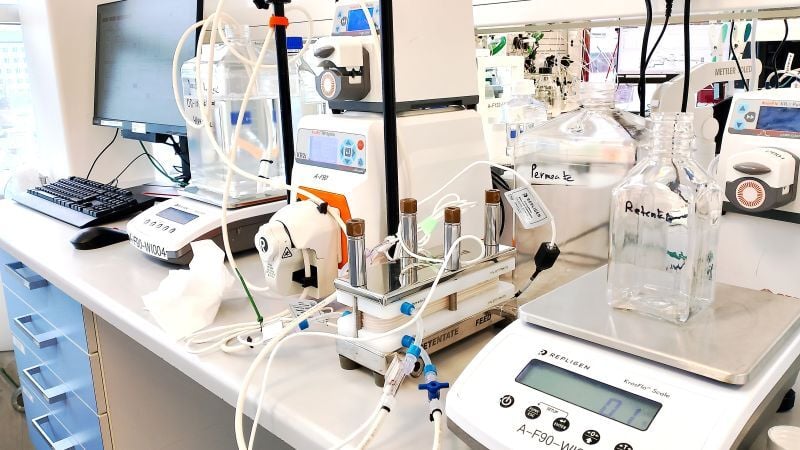
AGC Biologics implemented a 4 in-series SPTFF technology based on Cytiva´s Centramate™ filter holder and seven Pall™ T-series Centramate™ cassettes (Omega™ PES membrane, 30 kDa, 93 cm2). The 4 in-series SPTFF configuration had an effective membrane area of 0.0651m2.
In-line concentration was evaluated with a model monoclonal antibody (mAb1). We analyzed several variables, including feed concentration, feed and retentate pressures, and feed flow, to determine their impact on the final concentration factor.
|
Feed concentration |
Feed flow |
Feed pressure |
Retentate pressure |
Concentration achieved |
Concentration factor |
|
g/L |
LMH |
Bar |
Bar |
g/L |
X |
|
1.1 |
138 |
2.0 |
0.0 |
10.3 |
9 |
|
1.1 |
138 |
2.2 |
0.35 |
20.7 |
19 |
|
1.1 |
138 |
2.2 |
0.6 |
43.9 |
40 |
|
1.0 |
138 |
2.0 |
0.0 |
10.1 |
10 |
|
5.1 |
120 |
2.0 |
0.0 |
32.8 |
6 |
|
5.1 |
120 |
2.2 |
0.3 |
41.7 |
8 |
|
5.1 |
111 |
2.1 |
0.5 |
49.8 |
10 |
|
5.1 |
111 |
2.2 |
0.5 |
50.1 |
10 |
|
5.0 |
111 |
2.0 |
0.0 |
27.2 |
5 |
|
5.0 |
111 |
2.1 |
0.5 |
45.0 |
9 |
|
5.0 |
92 |
1.7 |
0.5 |
51.7 |
10 |
|
5.0 |
92 |
1.8 |
0.7 |
57.3 |
11 |
|
5.0 |
92 |
1.9 |
0.9 |
63.1 |
13 |
|
10.3 |
92 |
2.1 |
0.0 |
52.9 |
5 |
Table 1: Summary of selected SPTFF experimental runs with mAb1.
The Results
The concentration factor (X) exhibited a near-linear relationship with retentate pressure across the tested range (0 to 0.9 bar). This linear response was consistent for all feed concentrations evaluated (Figure 1).
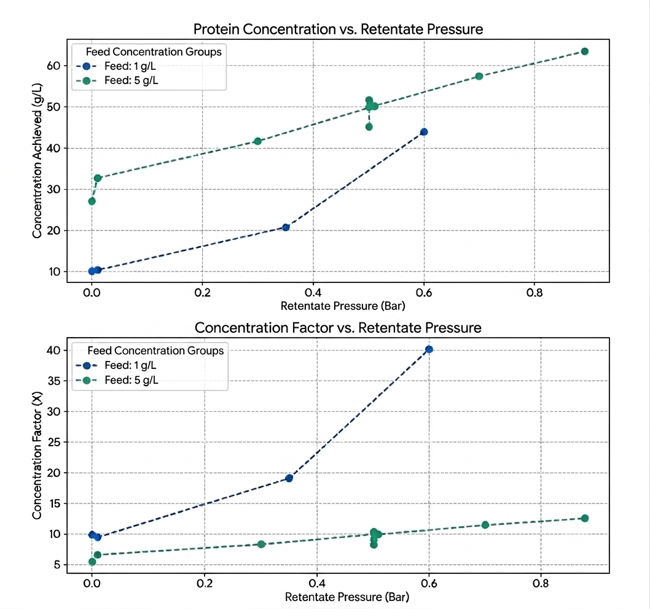
Figure 1. Concentration response to retentate pressure at different feed concentrations. Top panel: Total protein concentration achieved with different feed concentrations at varying retentate pressures. Bottom panel: Concentration factor achieved under these same conditions.
Notably, the achievable concentration factor was heavily dependent on the initial feed concentration. For example, a feed of ca. 1.0 g/L consistently achieved a concentration factor of approximately 40X at a retentate pressure of 0.6 bar. Furthermore, a 10X concentration was easily achieved with this feed even without applying backpressure (0.0 bar retentate pressure).
In contrast, using a higher starting feed of 5.0 g/L, the maximum concentration factor observed was 13X (resulting in 63.1 g/L) at a retentate pressure of 0.9 bar.
This in-line concentration occurred at competitive feed flows (92 to 138 LMH), which ensure short processing times compatible with in-line operation between chromatographic steps. The feed flow is conditioned directly by the feed concentration; higher concentrations increase viscosity and system feed pressures.
Overall process performance met expectations across all runs, with a summary of two representative runs provided in Table 2. Both feeds (1 g/L and 5 g/L) maintained a stable concentration factor of ca. 10X and achieved high total recoveries comparable to traditional TFF, consistently reaching ≥ 95%.
|
ELN number |
DD-103763 |
DD-103772 |
|
Feed conc (g/L) |
1.03 |
5.06 |
|
Feed flow (LMH) |
138.3 |
110.6 |
|
Target retentate pressure (Bar) |
0.0 |
0.5 |
|
|
||
|
Retentate concentration (g/L) |
10.1 |
50.1 |
|
Recovery (without flush) (%) |
91.6 |
93.4 |
|
Total recovery (%) |
95.3 |
97.4 |
|
Concentration factor achieved (X) |
9.8 |
9.9 |
Table 2: Summary of performance of selected SPTFF runs with mAb1.
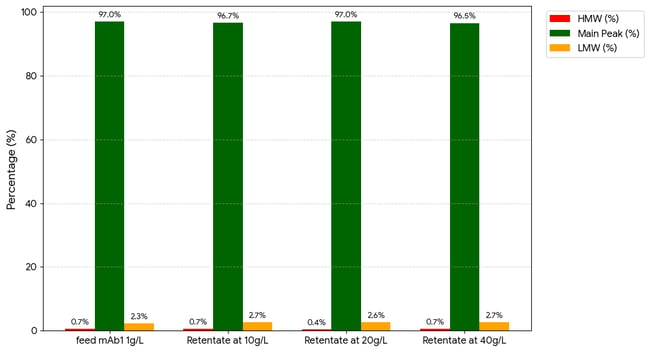
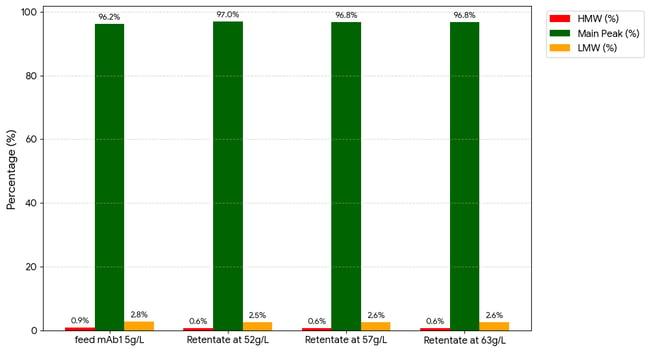
Figure 2. Size Exclusion Chromatography (SEC) data from mAb1 subjected to different SPTFF conditions. Top panel: data from a run with feed at 1 g/L. Bottom panel: data from a run with feed at 5 g/L.
Additionally, utilizing a single-pass approach maintained high product quality, with no increase in high molecular weight (HMW) or low molecular weight (LMW) species. This confirms that the reduced shear stress of SPTFF protects Critical Quality Attributes (CQAs). As shown in Figure 2, neither feed concentration (1 g/L or 5 g/L) exhibited a significant increase in HMW species upon reaching concentration factors of 10X. Notably, the 1 g/L feed was concentrated up to 40X without any negative impact on product quality as assessed by SEC.
Conclusion
The implementation of in-line SPTFF adds a powerful tool to the AGC Biologics portfolio, reinforcing our expertise in process intensification and integrated continuous manufacturing. We can successfully concentrate drug substances between 10x and 40x in-line while maintaining the highest quality standards. While this case study focused on a monoclonal antibody, the technology is applicable to complex molecules and new modalities (mRNA, viral vectors, etc.) and facilitates a smoother transition to high-titer, continuous manufacturing.