

3 min read
With more than 40 years of microbial process development expertise, AGC Biologics has helped partners navigate the full journey from feasibility through commercial-scale GMP manufacturing across both soluble and IB processes.
Key Takeaways:
- Yield Is Not Enough: A strong refolding yield does not prove structural equivalence to a correctly folded reference standard.
- Upstream Drives Downstream: Fermentation conditions directly affect inclusion body quality and determine how effectively the protein can be refolded.
- Early Analytical Integration: Integrating analytical characterization at every development milestone prevents costly rework at scale.
The Analytical Blind Spot That Derails Inclusion Body Microbial Inclusion Body Programs Before They Reach the Clinic
E. coli remains the most widely used bacterial host for recombinant protein production, with more than 120 approved biotherapeutics expressed in this system to date, including insulin, hormones, and cytokines.¹ When proteins are overexpressed in E. coli, they frequently accumulate as insoluble aggregates known as inclusion bodies (IBs), a phenomenon that has historically been viewed as a manufacturing obstacle.² However, advances in refolding technology, fermentation optimization, and analytical characterization have made IB expression a viable, high-yield production route for many molecules. The greater challenge is proving that the refolded protein meets the quality bar: correct higher-order structure, proper disulfide connectivity, purity, and confirmed biological activity. Development teams that treat that analytical burden as an afterthought rather than building it in parallel with process development risk stalling their programs before they reach the clinic.
How Is Structural Equivalence to a Reference Standard Demonstrated in IB Processes?
Regulators and CMC teams evaluating an IB-based process need more than yield data; they need a complete analytical package demonstrating that the refolded product is structurally equivalent to a correctly folded reference standard. At AGC Biologics, we demonstrate that equivalence using orthogonal methods: circular dichroism (CD) and FTIR spectroscopy for secondary structure, hydrogen-deuterium exchange mass spectrometry (HDX-MS) for higher-order conformational dynamics, and native MS for intact mass and oligomeric state. Disulfide mapping confirms correct bond pairing, purity profiling and aggregate detection control for process-related impurities and misfolded variants, and a functional assay verifies that the refolded molecule performs as intended. Building this evidence in parallel with process development, rather than retroactively, is the most reliable way to avoid surprises during scale-up or tech transfer.
How Do Upstream Fermentation Conditions Impact Downstream Refolding Success?
The quality of the analytical results described above depends on the quality of the inclusion bodies produced during fermentation. Upstream cultivation conditions have a direct effect on IB purity, morphology, and solubility, all of which shape how effectively the protein can be refolded downstream (Figure 1). AGC Biologics' Heidelberg Center of Excellence for Microbial Systems and Services applies DoE-guided screening and QbD principles to identify which fermentation variables most influence refolding performance and to define the operating window that produces consistent results.
Which Fermentation Parameters Directly Affect Inclusion Body Quality and Yield in Microbial Manufacturing?
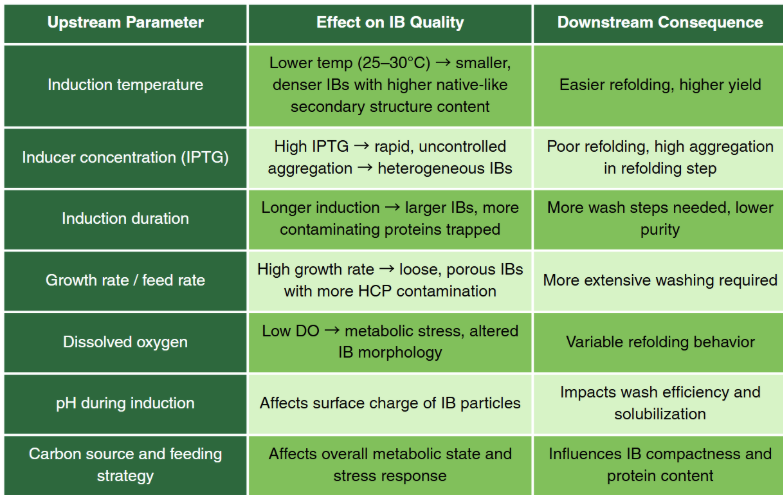
Figure 1. Fermentation conditions during IB expression directly affect downstream solubilization, refolding yield, and product purity.
Why Is Early Analytical Integration Required for Scaling Inclusion Body Programs?
As an IB-based process moves from lab scale to pilot and GMP manufacturing, both fermentation and refolding become more sensitive to volume, timing, and mixing behavior. IBs offer an operational advantage at this stage because they are stable, insoluble particles that can be stored and processed asynchronously rather than requiring a continuous workflow. That flexibility only holds, though, when the process has been fully characterized and analytically grounded before scale-up begins. AGC Biologics structures IB programs as a phased roadmap, with analytical readouts at each development milestone rather than consolidated at the end. Process scientists at our Heidelberg site have optimized IB refolding across a wide range of molecules and drug product candidates, and that depth of experience with established infrastructure and regulatory knowledge is what separates a well-controlled commercial process from one that requires costly rework at scale.
Analytical rigor and process control keep IB programs on track, but selecting the right expression strategy in the first place is just as critical. AGC Biologics' white paper, From Insoluble to Indispensable: Inclusion Bodies in Modern Biologics Development, covers refolding feasibility scoring, when to pivot to soluble expression, and cost-per-gram comparisons at commercial scale.
Read the full white paper: From Insoluble to Indispensable: Inclusion Bodies in Modern Biologics Development.
References:
- Rathore, A.S. et al. "Bioprocessing of inclusion bodies from E. coli to produce bioactive recombinant proteins." Biochemical Engineering Journal. (2024) 203:109188. doi: 10.1016/j.bej.2023.109188
- Bhatwa, A. et al. "Challenges Associated With the Formation of Recombinant Protein Inclusion Bodies in Escherichia coli and Strategies to Address Them for Industrial Applications." Frontiers in Bioengineering and Biotechnology. (2021) 9:630551. doi: 10.3389/fbioe.2021.630551
- Ohl, J., Lindner, R., Smith-Parker, J.C. "From Insoluble to Indispensable: Inclusion Bodies in Modern Biologics Development." AGC Biologics / BioSpace. (2026).