Key Takeaways:
-
Between 2015 and 2023, 88% of novel drug approvals involved expedited review programs, requiring faster manufacturing responses.
-
Traditional scale-up changes mixing and gas transfer parameters as vessels get larger; scale-out maintains a consistent 2,000L scale to bypass these studies.
-
Modular single-use systems allow for rapid technology transfer across global sites and align capital investment with actual market demand.
-
Integrating perfusion with scale-out platforms supports higher cell densities for complex molecules without increasing bioreactor footprint.
Biologics development is moving faster, placing immense pressure on manufacturing. Accelerated regulatory pathways, including FDA Breakthrough Therapy, Fast Track, and Regenerative Medicine Advanced Therapy designations, are compressing the timeline from investigational new drug (IND) application to commercial launch. Between 2015-2023, 88% of novel drugs and biologics approved by the FDA's Center for Drug Evaluation and Research involved at least one expedited development or review program.¹ For drug developers, particularly emerging and mid-size biotechs, this creates a question: how do you build a manufacturing strategy that keeps pace with compressed regulatory timelines without taking on excessive financial or technical risk?
For mid-size and large pharmaceutical developers with middle-to-late phase and commercial products, the concerns focus primarily on controlling the costs of production scale up and having a flexible manufacturing process that enables them to endure the ups and downs of an unpredictable market. How can you circumvent the challenges of traditional scale-up while adhering to aggressive timelines?
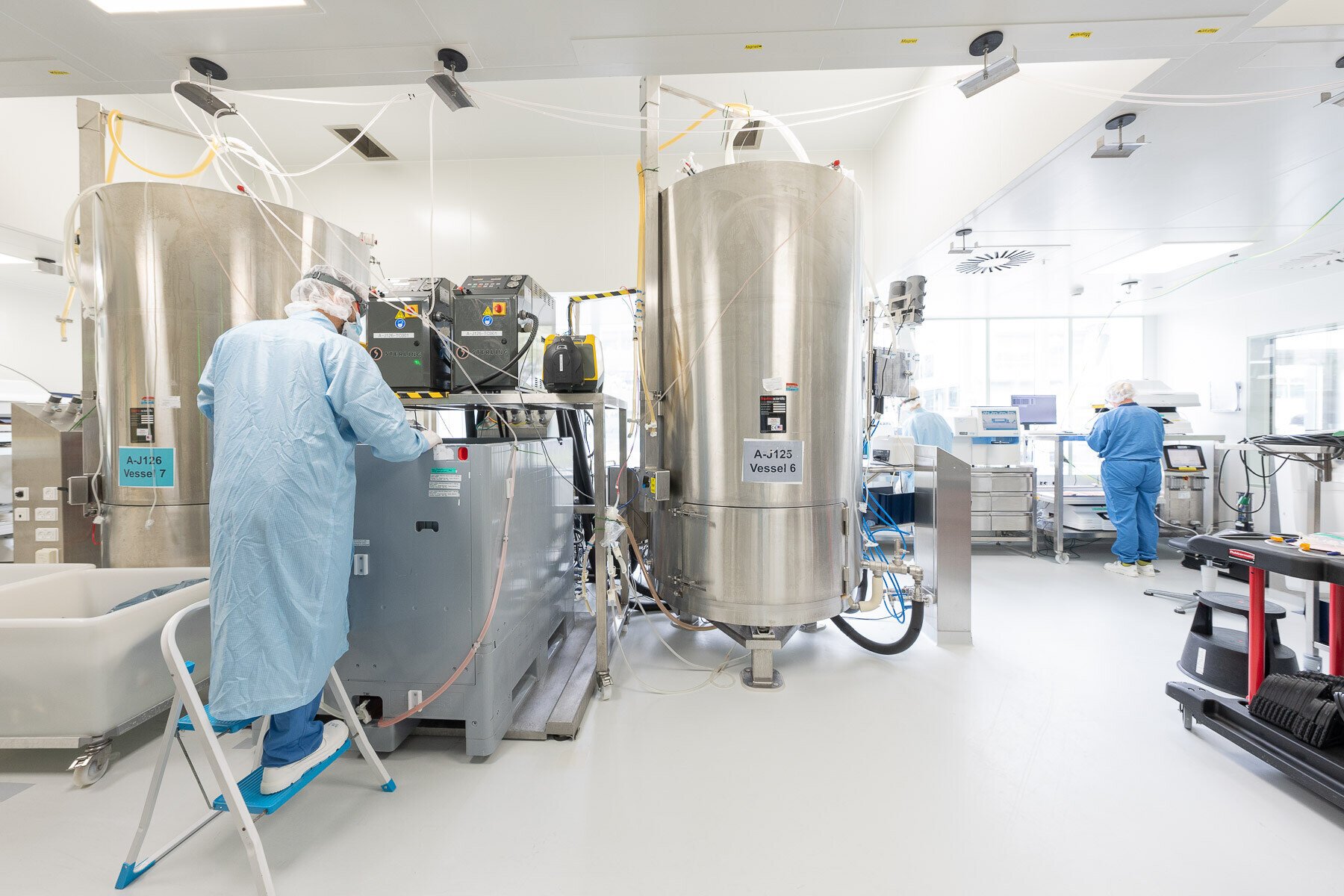
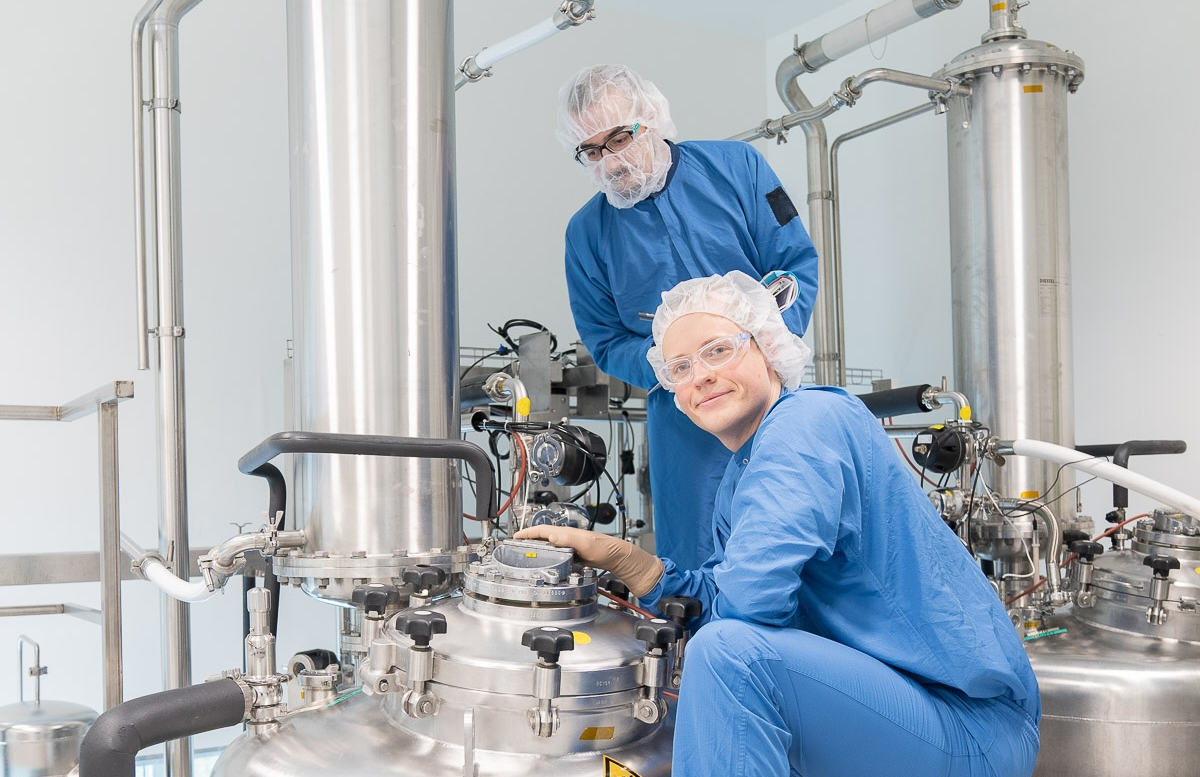
Rather than scaling up through progressively larger stainless-steel bioreactors, a growing number of developers are adopting scale-out strategies that use modular, single-use bioreactor systems to expand capacity in parallel. The global single-use bioprocessing market, valued at an estimated $31.71 billion in 2024, is expected to more than double by 2030, reaching a projected $74.09 billion² as companies prioritize this flexible approach.
Why is traditional scaling a risk for biologics?
Traditional biologics manufacturing follows a well-established trajectory: as molecule development advances, production moves into larger stainless-steel vessels. Each increase in bioreactor volume, however, alters internal process parameters such as mixing dynamics and gas transfer rates. These changes can affect cell culture performance and product quality, which in turn necessitates comparability studies.
The pressures of a compressed path to approval compound the challenge. Large-scale process development, equipment procurement, and process performance qualification (PPQ) campaigns require significant lead time and capital investment, usually well before a molecule's demand or commercial success is known. And once production is finally underway, the timelines for implementing new processes in stainless-steel facilities are often rigid, creating bottlenecks for programs that are moving on an accelerated track.
How does the scale-out model accelerate timelines?
Instead of increasing bioreactor volume, it maintains a consistent vessel size and adds parallel single-use bioreactor units to increase total output, a model that reduces regulatory complexity, lowers cost, and accelerates time to market.
Because the bioreactor scale remains the same from early-stage production through commercial manufacturing, the internal cell culture environment stays constant, and developers avoid the parameter changes that accompany traditional scale-up. This reduces comparability risk, streamlines PPQ and validation, and allows process knowledge generated at clinical scale to carry forward without the need for extensive new studies at each production milestone. The disposable nature of single-use systems eliminates cleaning validation requirements, further reducing operational complexity. And, in the event of a deviation within a single-use bioreactor, any product processed in parallel bioreactors may still be suitable for continued downstream processing, minimizing losses and preserving timelines.
From a capital perspective, scale-out reduces risk by aligning more closely with actual market demand rather than speculative forecasts. Financial commitments shift toward the approval milestone, rather than front-loading them years in advance. For emerging and mid-size biotechs managing financial resources through late-stage development, this alignment can be the difference between a sustainable program and an overextended one.
Can modular systems improve operational flexibility?
The operational advantages of scale-out become most apparent when real-world timelines and logistics are factored in. Because modular single-use platforms rely on standardized equipment and processes, they enable efficient technology transfer between manufacturing sites, something that traditional stainless-steel manufacturing struggles to support.
This exact scenario played out in practice when a developer partnering with AGC Biologics initiated production at one facility to meet an urgent timeline, then later needed to relocate manufacturing to a different site to address geographic requirements. In a traditional stainless-steel model, this type of transfer typically requires extensive revalidation and potentially months of additional process development. But the transfer was accomplished with significantly less disruption through AGC Biologic’s shared equipment configurations, aligned quality systems, and consistent single-use processes across sites, allowing production to seamlessly resume at the new location. The flexibility to shift production across geographies without sacrificing process consistency also gives developers a safeguard against the supply chain disruptions that have become an increasing concern across the industry.
The agility of the scale-out model is especially important for companies navigating the unpredictability of accelerated pathways, where conditional approvals or adaptive regulatory strategies may require manufacturing adjustments. The flexibility also extends as a program matures, where capacity can be expanded by running additional parallel batches if demand exceeds projections or additional indications are approved, rather than investing in a novel large-scale process.
Where does perfusion fit into a scale-out strategy?
While fed-batch production remains widely used across the biologics industry, perfusion-based manufacturing is gaining traction as pipelines shift toward more complex molecules and personalized therapies. For certain therapeutic proteins and novel antibody formats, conventional fed-batch processes may not deliver the output needed to support cost-effective commercial production. Perfusion addresses this by enabling continuous medium exchange within the bioreactor, sustaining higher cell densities and increasing material yield, even from processes with inherently low titers.
When integrated with modular single-use platforms, perfusion extends the scale-out model to complex biologics that have historically required large stainless-steel infrastructure to produce at commercial volume. Perfusion can also serve as a seed train intensification strategy within a fed-batch process, reaching higher cell densities before inoculating the production bioreactor. This gives developers a path to increased output without moving to larger vessel sizes, preserving the consistency and comparability advantages that scale-out provides.
Why choose a flexible manufacturing partner?
AGC Biologics has built its mammalian manufacturing platform around the scale-out model, supporting both fed-batch and perfusion workflows at production scale. The company's proprietary 6Pack System™ enables production at scales ranging from 2,000 to 12,000 liters using parallel single-use bioreactors, without triggering the comparability risk associated with traditional scale-up to larger vessels. For developers on accelerated regulatory pathways seeking manufacturing flexibility without sacrificing process consistency, or companies looking for ways to control or modulate costs in an unpredictable market, the scale-out approach offers a practical path from IND to commercial launch.
Read the full discussion on modular bioreactor strategy with AGC Biologics Principal Scientist Anders Cai Holm Hansen on BioSpace.com.
_____________________________
Read the Article
Resources:
1. United States Food and Drug Administration, Center for Drug Evaluation and Research. "9 Things to Know About CDER’s Efforts on Rare Diseases." U.S. Food and Drug Administration, 2024, www.fda.gov/drugs/things-know-about/9-things-know-about-cders-efforts-rare-diseases.
2. Grand View Research. "Single-Use Bioprocessing Market Size, Share & Trends Analysis Report, 2025–2030." Grand View Research, 2024, www.grandviewresearch.com/industry-analysis/single-use-bioprocessing-market.